Introduction
The University of Madras fake degree scam in Tamil Nadu exposed a serious instance of academic fraud involving forged undergraduate and postgraduate degree certificates. These fake degrees were detected during document verification processes conducted for overseas employment applications. The case revealed how illegal middlemen prepared and circulated counterfeit university certificates, exploiting job aspirants seeking international opportunities.
This incident highlighted the growing challenge of academic document fraud in the context of global employment and migration, where educational qualifications play a decisive role in eligibility and trust.
About the University of Madras
The University of Madras is one of India’s oldest and most respected public universities. It offers undergraduate, postgraduate, and doctoral programs through its departments and affiliated colleges. Degrees issued by the university are widely recognized for higher education, government jobs, private employment, and overseas migration.
Because of its long-standing reputation and acceptance, the university’s name carries significant weight in domestic and international verification processes. This credibility also makes it a frequent target for individuals involved in producing forged academic documents.
Detection of Fake Degrees During Overseas Employment Verification
The fake degree scam came to light when discrepancies were identified during academic document verification for overseas employment. Verification agencies noticed inconsistencies between submitted University of Madras degree certificates and official university records.
Common red flags included mismatched registration numbers, incorrect course durations, fabricated examination years, and formatting inconsistencies that did not align with genuine university certificates. These findings led to deeper scrutiny and formal complaints.
Nature of the Forged Undergraduate and Postgraduate Degrees
The seized forged documents included:
Fake undergraduate degree certificates
Fake postgraduate degree certificates
Provisional certificates and consolidated academic records
Supporting letters falsely claiming course completion
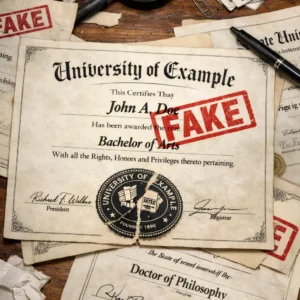
The counterfeit certificates were designed to closely resemble original University of Madras documents, using similar fonts, layouts, seals, and signatures. However, none of the individuals named on the documents had valid academic records with the university.
Role of Middlemen in the Fake Degree Scam
The scam was driven by middlemen who acted as intermediaries between job aspirants and document forgers. These individuals posed as education consultants or overseas job facilitators, offering quick academic documentation for a fee.
Their operations typically involved:
Collecting personal details from candidates
Selecting desired degree programs and graduation years
Coordinating with printers to produce forged certificates
Delivering fake documents for use in overseas job applications
In many cases, candidates were falsely assured that the certificates were genuine and would pass verification.
Use of Fake Degrees for Overseas Employment
The forged University of Madras degrees were primarily used for overseas employment opportunities. Many countries require verified academic qualifications as part of work visa processing and employment eligibility checks.
The fake degrees were submitted for:
Skilled and semi-skilled job roles
Professional employment categories
Migration and work visa applications
Credential assessments conducted by foreign authorities
Once detected, these fake documents resulted in visa rejections, employment cancellations, and permanent negative records for the applicants involved.
Police Investigation and Arrests
Following the detection of forged degrees, law enforcement agencies launched investigations that led to the arrest of middlemen involved in preparing and distributing fake University of Madras certificates. Raids resulted in the seizure of:
Forged degree certificates
Printing equipment and digital design files
Fake university seals and letterheads
Lists of beneficiaries and financial records
Criminal cases were registered under laws related to forgery, cheating, impersonation, and criminal conspiracy.
Consequences for Job Aspirants
Candidates found using fake University of Madras degrees faced severe consequences, including:
Rejection from overseas employment
Cancellation of work visas and job offers
Criminal investigation depending on involvement
Long-term damage to career prospects
Loss of credibility with future employers
Even candidates who claimed ignorance were often penalized due to strict verification policies in international recruitment.
Impact on Genuine University of Madras Graduates
The exposure of the fake degree scam affected legitimate graduates of the University of Madras. Increased scrutiny resulted in:
Delays in document verification
Additional authentication requirements
Heightened suspicion during overseas processing
Extended timelines for employment approvals
Genuine graduates had to provide extensive proof to establish the authenticity of their qualifications.
Systemic Challenges in Academic Verification
The case highlighted several systemic weaknesses:
Heavy reliance on physical certificates
Delays in cross-border academic verification
Lack of awareness among candidates about official processes
Exploitation of urgency for overseas employment
These gaps allowed fraud networks to operate until rigorous verification exposed the forged documents.
Strengthening Academic Integrity and Verification
Authorities and institutions emphasized the importance of:
Direct verification from issuing universities
Digitization of academic records
Increased coordination between universities and verification agencies
Public awareness against fake degree agents
Strict legal action against document forgers
Universities reiterated that legitimate degrees can only be obtained through formal education and official issuance channels.
Lessons from the University of Madras Fake Degree Scam
This scam offers important lessons:
No legitimate degree can be obtained without completing academic requirements
Fake certificates are eventually detected during verification
Overseas employment processes involve strict scrutiny
Trusting unauthorized middlemen often results in legal and financial loss
Academic integrity is essential for sustainable career growth
Broader Implications for Overseas Employment and Migration
Academic fraud damages international trust in Indian educational qualifications. Repeated detection of fake degrees leads to stricter verification processes for all applicants, increasing compliance burdens and delays for genuine candidates.
Such incidents highlight the need for stronger institutional safeguards and transparent verification systems.
Conclusion
The University of Madras fake degree scam in Tamil Nadu exposed a significant academic fraud network that exploited the reputation of a prestigious public university for overseas employment misuse. The seizure of forged undergraduate and postgraduate degrees and the arrest of middlemen demonstrated the scale and seriousness of the operation.