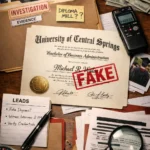
The discovery of thirteen fake law degrees during document verification at Chaudhary Charan Singh University represents a significant breach in the credibility of professional education. These fraudulent Bachelor of Laws and integrated law degrees, allegedly issued between 2005 and 2023, expose how academic manipulation can persist over nearly two decades before being detected. The case highlights the growing importance of systematic verification and the vulnerabilities that exist within credential validation processes.
Law degrees carry exceptional responsibility, as they qualify individuals to participate directly in the justice system. The revelation that forged legal qualifications went undetected for years raises serious questions about oversight, regulatory mechanisms, and the potential consequences for public trust.
How the Fake Degrees Were Detected
The fraudulent degrees came to light during a routine but intensified document authentication process conducted by CCS University. Officials noticed discrepancies in enrollment records, roll numbers, examination data, and issuance dates. Upon deeper scrutiny, it was found that these degrees had no corresponding academic trail within the university’s official archives.
In some cases, student names were missing from admission registers. In others, marksheets did not match examination schedules or subject structures that were in place during the claimed academic years. The irregularities were serious enough to conclude that the degrees were entirely fabricated.
Time Span Reveals Systemic Vulnerability
One of the most alarming aspects of this case is the time span involved. The fake degrees reportedly dated back to 2005 and continued as recently as 2023. This suggests that the problem was not isolated to a single incident or individual but may reflect a recurring vulnerability exploited over many years.
The long duration raises concerns about how many similar cases may remain undetected and whether additional fraudulent degrees exist within or beyond the identified set.
Law Degrees and the Risk to the Justice System
Legal education is not merely an academic pursuit; it is the foundation for advocacy, judicial service, corporate compliance, and legal advisory roles. Individuals holding fake law degrees may have appeared in courts, drafted legal documents, or advised clients without legitimate qualifications.
Such situations pose a direct risk to justice delivery. Incorrect legal representation can lead to wrongful outcomes, procedural errors, and loss of faith in the legal system. The presence of unqualified individuals within the profession undermines ethical standards and professional accountability.
Possible Origins of the Fraud
Investigators are examining multiple possible sources behind the fake degrees. These include unauthorized intermediaries, forged documentation networks, and the misuse of legacy records from periods when digitization was limited.
Some degrees may have been created entirely outside the university using fabricated seals and signatures, while others could involve manipulation of internal records. The involvement of external agents specializing in academic fraud is also under scrutiny.
The investigation aims to determine whether this was an organized racket or a series of independent forgeries.
Verification Gaps and Legacy Record Challenges
The case highlights challenges associated with verifying older academic records. Many universities relied on manual record-keeping in the early 2000s, making verification more complex and time-consuming.
Fraudsters often exploit these gaps by targeting degrees from periods where digital footprints are minimal. Without centralized databases or automated cross-checks, such fake credentials can circulate for years without detection.
The CCS University case underscores the urgent need to modernize record management and verification systems.
Impact on Employers and Regulatory Bodies
Fake law degrees do not affect only the university. Employers, bar councils, and licensing authorities rely on the authenticity of academic credentials to determine eligibility.
If forged degrees pass through initial checks, they compromise recruitment integrity and regulatory enforcement. This places additional pressure on professional bodies to strengthen their own verification mechanisms and collaborate more closely with universities.
The exposure at CCS University may prompt wider audits across institutions and professions.
Legal Consequences for Degree Holders
Individuals found using fake law degrees may face severe legal consequences. These can include criminal charges related to forgery, fraud, and misrepresentation, as well as disqualification from professional practice.
Those who used such degrees to secure employment or benefits may also face termination, recovery of salaries, or further prosecution depending on the circumstances.
The case sends a clear message that possession and use of fake credentials carry long-term legal risks.
Institutional Accountability and Internal Review
CCS University has initiated internal reviews to determine how these fake degrees bypassed earlier checks. This includes examining verification protocols, staffing practices, and response mechanisms for suspicious cases.
Universities across the country are likely to reassess their own systems in light of this case. Institutional accountability is essential not only for preventing future fraud but also for restoring confidence among stakeholders.
Transparency in investigation outcomes will be critical.
Broader Pattern of Academic Fraud in Professional Courses
The CCS University incident fits into a broader pattern of academic fraud affecting professional courses such as law, medicine, engineering, and education. These degrees are often targeted because of their high demand and professional value.
Fake credentials in such fields have more serious consequences than general academic fraud, as they directly affect public services, safety, and governance.
Addressing this issue requires sector-specific safeguards rather than generic solutions.
The Role of Continuous Verification
One key lesson from this case is that verification should not be a one-time process. Continuous and periodic verification, especially during licensing, promotions, and reappointments, can help identify irregularities that were missed earlier.
Universities, regulators, and employers must treat credential verification as an ongoing responsibility rather than a procedural formality.
Need for Centralized Degree Validation Systems
The exposure of fake law degrees strengthens the case for centralized academic verification systems. Secure digital records, tamper-proof degree certificates, and real-time validation portals can significantly reduce the scope for fraud.
Such systems would also ease the burden on universities and employers while improving accuracy and accountability.
Investment in technology is essential to protect academic integrity.
Conclusion
The discovery of thirteen fake law degrees at Chaudhary Charan Singh University is not just an isolated incident; it is a warning sign of deeper structural challenges in academic verification. The long time span of the fraud, the professional nature of the degrees involved, and the potential impact on the justice system make this case particularly serious.
Strengthening verification mechanisms, improving record management, and enforcing accountability are no longer optional. As this case demonstrates, safeguarding the credibility of education is fundamental to protecting institutions, professions, and public trust.