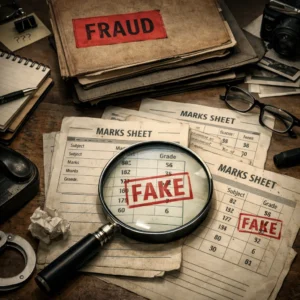
Academic qualifications form the backbone of professional credibility, especially in public sector roles such as teaching, administration, and technical services. When fake certificates enter these systems, they threaten not only institutional integrity but also the quality of education and public trust. The Allahabad Agricultural Institute fake certificate case in Uttar Pradesh is a striking example of how forged academic documents were misused during teacher recruitment, leading to the exposure of a wider fraud network involving agents and intermediaries.
This case came to light after recruitment authorities detected discrepancies in educational documents submitted by several candidates applying for teaching positions. What initially appeared to be isolated irregularities soon revealed a systematic operation centered on fake marksheets and degrees circulated under the name of a reputed agricultural institute.
Background of the Case
Allahabad Agricultural Institute has long been associated with agricultural education and research. Its name carries weight in academic and professional circles, particularly in education and allied sectors. Fraudsters exploited this credibility by producing counterfeit certificates that appeared authentic enough to pass basic scrutiny.
Candidates seeking government teaching jobs submitted marksheets and degree certificates claiming affiliation with the institute. However, during advanced verification stages, authorities noticed inconsistencies in enrollment numbers, examination years, and academic progression. These anomalies triggered a deeper investigation.
How the Fake Certificate Racket Was Uncovered
Teacher Recruitment Verification Process
The exposure occurred during document verification for teacher recruitment, a process known for strict academic validation. Recruitment boards cross-checked certificates with institutional records to ensure candidates met eligibility requirements.
Several candidates failed verification when the institute could not confirm their enrollment, examination records, or degree issuance. In many cases, candidates could not produce supporting documents such as admission letters, semester-wise marksheets, or attendance records.
Detection of Forged Marksheets and Degrees
Authorities identified patterns in the forged documents, including:
Similar formatting and serial numbering across different candidates
Inconsistent fonts and seals compared to genuine certificates
Degree issue dates that did not match academic calendars
Marksheets showing subjects and grading schemes that were no longer in use
These similarities suggested centralized production rather than individual forgery attempts.
Role of Agents and Intermediaries
Investigations revealed that agents played a key role in circulating fake certificates. These intermediaries approached job aspirants, particularly those struggling to meet eligibility criteria, and offered complete degree packages for a fee.
Candidates were reportedly promised that the documents would be “valid for recruitment” and that verification would not pose an issue. In reality, the agents relied on the assumption that not all documents would be thoroughly checked, especially during initial screening stages.
The involvement of organized intermediaries transformed the issue from isolated fraud into a structured racket.
Police Investigation and Legal Proceedings
Once recruitment authorities reported the discrepancies, law enforcement agencies launched formal investigations. Police examined seized documents, traced communication records, and questioned candidates and agents involved in the transactions.
Key aspects of the investigation included:
Identifying printing and document fabrication sources
Tracking financial transactions linked to certificate sales
Determining whether institutional data had been misused or fabricated entirely
Establishing the extent of the racket across districts and recruitment cycles
Police registered cases against agents and facilitators on charges related to forgery, cheating, impersonation, and criminal conspiracy. Candidates found knowingly using fake certificates were also subjected to legal scrutiny.
Impact on Teacher Recruitment and Education Quality
Threat to the Education System
The case raised serious concerns about the quality of education in public institutions. Teachers play a foundational role in shaping students’ futures, and unqualified individuals entering the system through forged credentials pose long-term risks to educational standards.
Disqualification and Appointment Cancellations
Several candidates were disqualified from the recruitment process, and appointments already made were canceled after verification failures. This led to delays in filling teaching positions and increased administrative burdens for recruitment authorities.
Increased Verification Burden
Following the exposure, recruitment boards intensified document scrutiny, resulting in longer verification timelines. Genuine candidates faced additional checks, even when their qualifications were legitimate, highlighting the collateral impact of academic fraud.
Consequences for Candidates Using Forged Documents
Candidates implicated in the case faced serious consequences, including:
Immediate rejection from recruitment processes
Termination from positions already secured
Blacklisting from future government recruitment
Criminal charges under forgery and fraud laws
Authorities emphasized that ignorance or reliance on agents does not absolve candidates of responsibility when forged documents are used for personal gain.
Broader Pattern of Fake Certificate Rackets
The Allahabad Agricultural Institute case reflects a broader national issue where fake certificates are circulated using the names of reputed institutions. Such rackets thrive on high competition for government jobs, lack of awareness, and reliance on intermediaries.
Advancements in printing technology and digital design have made forged documents increasingly sophisticated, necessitating equally advanced verification mechanisms.
Importance of Academic Verification and Record Integrity
This case reinforces the importance of transparent and secure academic record systems. Direct verification from institutions, authenticated transcripts, and centralized digital records are critical tools in combating certificate fraud.
Recruitment authorities and employers are increasingly shifting toward primary-source verification, reducing dependence on physical copies that are vulnerable to manipulation.
Lessons for Students, Employers, and Institutions
For Job Aspirants
The case serves as a warning against taking unethical shortcuts. Degrees and marksheets obtained without genuine academic effort can lead to legal trouble, career setbacks, and long-term reputational damage.
For Recruitment Bodies
Strict and consistent verification processes are essential, even when faced with large volumes of applications. Early detection helps prevent unqualified candidates from entering sensitive roles.
For Educational Institutions
Institutions must protect their academic identity, strengthen internal record-keeping, and cooperate with authorities to prevent misuse of their name and credentials.
Conclusion
The Allahabad Agricultural Institute fake certificate case in Uttar Pradesh underscores the serious consequences of academic fraud in public recruitment. What began as verification discrepancies during teacher selection revealed a deeper network of agents distributing forged marksheets and degrees.
This case highlights a critical reality: academic integrity is fundamental to public trust, especially in sectors like education. Genuine qualifications, earned through proper study and assessment, remain the only reliable foundation for sustainable careers and institutional credibility.
As verification systems continue to evolve, cases like this stand as cautionary examples, reminding candidates, recruiters, and institutions alike that shortcuts in education carry lasting and often irreversible consequences.